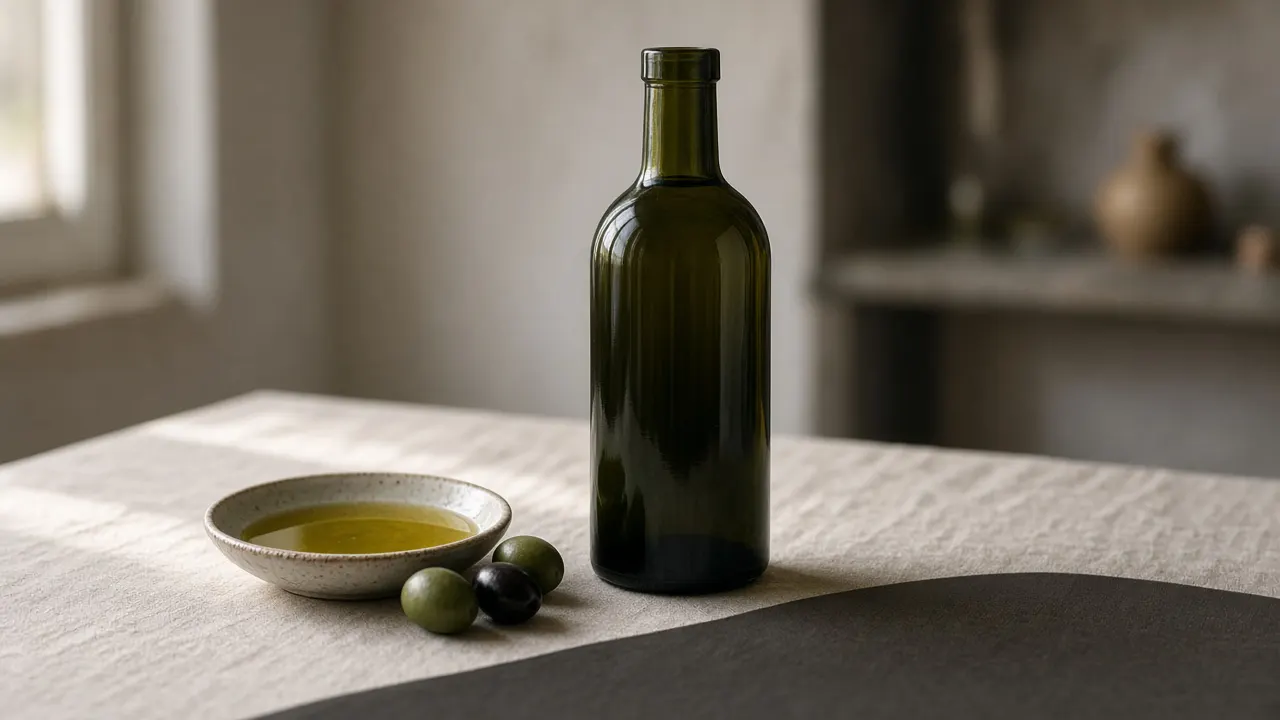
How to Choose Your EVOO
Five checks for extra virgin olive oil: the container, the grade, the farming, the country, and the harvest date.
Overview
Any olive oil in plastic fails this shopping standard, even when the oil is organic. Choose extra virgin oil in dark glass, tin, or steel, from one country, with a harvest date in the last year or so. A bitter tongue and a peppery throat are signs the oil is still fresh. “Product of Italy” can mean the oil was only bottled there. The Index rates olive oil as an ingredient. It does not yet score the bottle.
- Plastic is an automatic no, even when the oil inside is organic.
- Choose dark glass, coated tin, or steel. Clear glass is a step down because light ages the oil.
- Look for extra virgin, one country, and a harvest date you can read.
- Bitterness on the tongue and a peppery sting in the throat are signs of fresh oil.
- The Index rates the ingredient. These five checks are how you judge the bottle.
- Any plastic bottle or pouch.
- The words “pure,” “light,” or pomace.
- “Product of Italy” with several country codes on the back.
- “Mediterranean blend,” with no estate or region.
- A best-by date and no harvest date.
- A flat, buttery, popcorn, or cardboard smell.
- Clear glass that has been sitting under shop lights.
What & Where to Buy

aToxiq Labs may earn a commission when you buy through marketplace links. It never influences a hazard rating.
Deep Learning & Science
Extra virgin olive oil can be a clean ingredient and still be a poor bottle. Fat picks up what it sits in, light ages the oil, and a pretty origin story on the front can hide a blend on the back. This guide is the shopping standard we want you to use in the aisle.
The Index rates a product from the ingredients on its label. Olive oil itself can rate Clean and still sit in plastic, in clear glass, or in a vague blend. These five checks are not wired into the Index yet. Until they are, read the bottle in your hand.
Plastic fails, even when the oil is good
Edible oil is a fat. Fat can carry fat-soluble chemicals out of a plastic wall, and oxygen moves through plastic more easily than through glass, which ages the oil. In this standard, any plastic bottle or pouch fails. The rule does not make an exception for organic oil or a cold press.
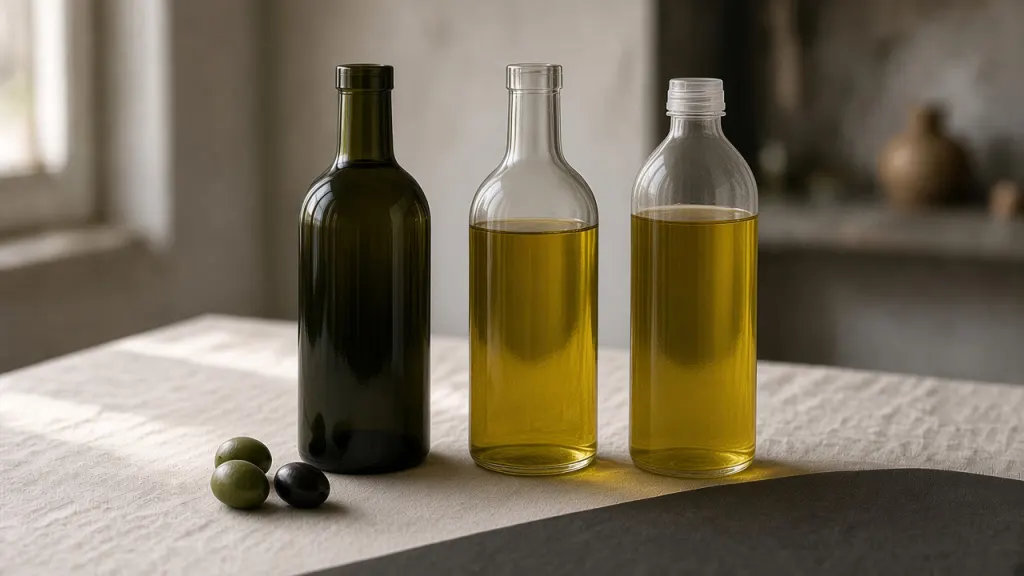
The containers that pass are dark glass, coated tin that is not lined with BPA, and food-grade stainless steel. Clear glass is a step down. Chlorophyll in the oil reacts to shop lighting, and the oil goes stale faster. If clear glass is what you have, keep it in a dark cupboard, away from the stove.
Five checks before you buy
Read the bottle against these five lines. A plastic container, a refined grade, or a multi-country blend fails on its own. Clear glass, conventional farming, a missing harvest date, or a single country with no regional seal is Use Caution. Clean means the bottle clears every line.
| Check | Clean | Use Caution | Avoid |
|---|---|---|---|
| Packaging | Dark glass, coated tin, or stainless steel. | Clear glass. Light ages the oil. Store it in a dark cupboard. | Any plastic bottle or pouch. |
| Grade | Extra virgin, from a first cold press. Acidity at or under 0.5% when the bottle prints it. | Extra virgin with acidity between 0.5% and 0.8%, or virgin oil with no certification. If acidity is not printed, you cannot check this number. | Refined, “pure,” “light,” or pomace oil, or a blend with seed oils. |
| Farming | Certified organic, biodynamic, or a small estate that can show it does not spray. | Conventional extra virgin oil. Pesticides can stay in the fat. | A bulk crop with no way to check pesticide use. |
| Origin | One country, with a PDO, DOP, PGI, IGP, or California Olive Oil Council seal, and a lot you can trace. | One named country, with no regional seal. | “Mediterranean blend,” or “Product of Italy” when the back lists several countries. |
| Harvest | A harvest date on the bottle, from the last 12 to 14 months. | A best-by date only. | No date, or more than 24 months after harvest. |
This is a shopping standard. The Index does not score bottles with this table yet.
The legal ceiling for extra virgin oil is looser than this table. Many honest bottles never print an acidity number. When the number is missing, you cannot fail the bottle for it. Use packaging, grade words, origin, and the harvest date instead.
In the aisle
- If the bottle is plastic, put it back. Organic on the front does not change that.
- Prefer dark glass, coated tin, or steel. Clear glass is a compromise.
- The front should say extra virgin. Put back “pure,” “light,” and pomace.
- Turn it over. One country is the goal. A list of country codes, or “blend of Mediterranean oils,” fails.
- Look for a PDO, DOP, PGI, IGP, or California Olive Oil Council seal when you want a certified region.
- Find a harvest date, not only a best-by date. Favor oil from the last 12 to 14 months.
- If acidity is printed, this standard wants 0.5% or under. If it is not printed, skip that number and use the other checks.
- At home, taste a teaspoon. Bitter and peppery is a good sign. Flat, greasy, popcorn, or cardboard is not.
“Product of Italy” is a bottling claim
Seals that tie the oil to a place: PDO and DOP mean the olives were grown, milled, and packed in a named region under audited rules. PGI and IGP confirm a regional product with checked production rules. The California Olive Oil Council seal is a chemical and sensory check for California oil. A seal is a plus. It does not excuse a plastic bottle.
Smoke point is the wrong test
Culinary marketing treats a high smoke point as proof that an oil is the one to cook with. Smoke point marks the temperature where leftover free fatty acids and other volatile bits start to smoke. It does not measure how fast the fat itself breaks down.
Extra virgin olive oil is mostly oleic acid, a monounsaturated fat with one double bond. Many seed oils are high in polyunsaturated fats, which oxidize faster when heat and oxygen are both present. De Alzaa, Guillaume, and Ravetti heated commercial oils and measured the breakdown products. In that 2018 study, extra virgin olive oil produced fewer polar compounds than the refined seed oils in the test, including oils with higher smoke points.
Three compounds in the oil
The fat is most of the bottle. A small fraction of polyphenols is what makes fresh extra virgin oil taste alive, and it is what the studies below actually measured. The findings are mechanisms and trial markers. They are not a claim that olive oil treats a disease.
Oleocanthal. Beauchamp and colleagues reported in Nature in 2005 that oleocanthal inhibits the COX-1 and COX-2 enzymes in a lab assay in a pattern that resembles ibuprofen. Peyrot des Gachons and colleagues later showed that the peppery sting in the throat comes from oleocanthal acting on the TRPA1 receptor, which sits in the throat rather than across the whole mouth. That sting is a freshness clue you can taste. It is not a dose of painkiller, and it is not a reason to skip medicine.
Hydroxytyrosol. The European Food Safety Authority allows one narrow claim: olive-oil polyphenols help protect blood lipids from oxidative damage. The claim applies only when the oil provides at least 5 mg of hydroxytyrosol and its derivatives per 20 g, and it is tied to eating 20 g of that oil in a day. A bottle that does not state this level has not earned the claim. In the EUROLIVE trial, Covas and colleagues gave healthy men olive oils that differed in polyphenols and little else. HDL cholesterol rose, and a marker of oxidative damage fell, as the polyphenol level rose. Lucas, Russell, and Keast review the inflammation pathway in more detail.
Oleuropein. Rigacci and colleagues reported that oleuropein aglycone turned on a cell-cleanup pathway, via AMPK and lower mTOR, in cultured cells and in mice. de Pablos and colleagues reviewed hydroxytyrosol research along similar lines, including autophagy. Those are laboratory and review findings.
The ingredient card rates the oil’s chemistry. Packaging, origin, and harvest date are separate checks. A Clean ingredient does not promote a plastic bottle to Clean.
The throat and tongue test
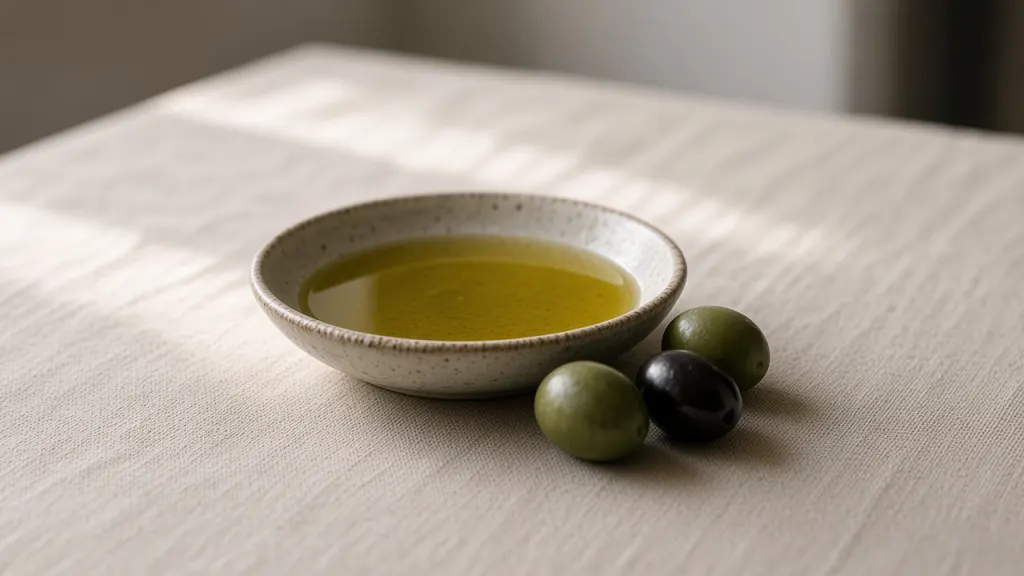
You do not need a lab to notice a tired oil. Pour a teaspoon, with no bread.
- Swirl it on the tongue. A clean bitterness points to fresh oleuropein. Peyrot des Gachons and colleagues describe the related throat sensation in the 2011 Journal of Neuroscience paper.
- Swallow. A peppery sting, sometimes a single cough, is oleocanthal on the TRPA1 receptors in the throat. Producers sometimes call these one-cough or two-cough oils.
- Flat or thin points to refining, or to dilution with an oil that has no polyphenols left.
- Buttery or movie-popcorn points to oxidation, the stage where the fat has broken into compounds such as diacetyl.
- Greasy or heavy points to fruit that was damaged or stored too long before milling.
- Cardboard or paint-varnish points to a later rancid stage, with aldehydes such as hexanal.
One example, and how to read it
The brief for this guide uses Terra Delyssa as an example of a single-country Tunisian oil, pressed from Chemlali and Chetoui olives, bottled in dark glass, with a QR code the brand uses for harvest and lot details. We have not tasted that oil or sent it to a lab for this page, and we are not naming a store. If you pick a bottle up, read that bottle: one country, a harvest date, dark glass or tin, and no plastic.
We are not attaching catalog olive oils to this guide. A Clean rating on the Index today means the ingredient list passed. It does not mean the bottle passed the five checks above.
Extra Virgin Olive Oil (EVOO)
On labels it can appear as: OLEA EUROPAEA FRUIT OIL, UNREFINED OLIVE OIL, extra virgin olive oil, huile d’olive extra vierge
Read the full science card